986 years ago, on this day, June 27, in Krakow, Ladislaus I, Saint Ladislaus (Croatian: Ladislav I, Latin: Ladislaus I.), our medieval Hungarian king, was born
King Saint Ladislaus was canonized in June 1192, at the initiative of King Béla III of Hungary, with the approval of Pope Celestine III.
The ceremony and the recognition of the miracles that occurred at his tomb took place in the cathedral of Várad (now Oradea, Romania). The purpose of the canonization: Béla III wanted to increase the authority of the Árpád House and his own power with the canonization, as well as to legitimize the glorious past of the dynasty.
As a prelude to the canonization, the first, so-called ancient legend of the king was born in Várad. This text collected his exploits and the miraculous healings that occurred at his grave.
The best-known element of the legend, which tells the story of the battles against the invading Cumans and Pechenegs and the hero who saved his daughter.
The Water-drawing: miracles of water through prayer, which are said to have helped thirsty armies during campaigns.
The Miracle of the Deer: the story according to which a miraculous deer showed the way to the founding of the Várad monastery.
The tomb of King Ladislaus, the Várad Cathedral, soon became one of the most significant and most visited pilgrimage sites in medieval Hungary.
The king was born on June 27, 1040 in Krakow, Poland. Died: July 29, 1095, in Nitra in the Highlands (present-day Slovakia) Spouse: Queen Adelhaid of Hungary. Burial place: Oradea Cathedral. Children: Saint Piroska. Siblings: Queen Ilona of Croatia, Prince Lampert of Hungary.
King of Hungary and King of Croatia from 1077 until his death in 1095. Second-born son of King Béla I and Queen Richeza. He is credited with strengthening the protection of private property, the partial conquest of Croatia (1091) and the canonization of the first Hungarian saints. He himself was canonized in 1192 and is also called the “athlete of God” due to his exceptional physique.
After a series of internal conflicts, Ladislaus had to restore public order, and he punished theft and robbery with mutilation or death. In 1091, he conquered most of Croatia, which marked the beginning of the expansion of the medieval Kingdom of Hungary. In the east, he defeated the Cumans and Pechenegs, securing the eastern borders for 150 years. In his last years, his relationship with the Holy See deteriorated precisely because of the Croatian conquest, because the pope considered the acquired Croatian territory as his own fiefdom, but Ladislaus did not recognize this.
Legends present him as a pious knight-king, as the embodiment of the knightly ideal of the late chivalric period. He is a popular saint in Hungary and the surrounding countries, and he is the patron saint of many churches. Several relics and objects that have survived to this day can be associated with the canonized king. Such are, for example, the St. Ladislaus herma in the Basilica of Győr, as well as his right, which is kept in the Franciscan monastery in Dubrovnik.
During his reign, the foundations of the royal ceremonial order were laid, which contributed to the strengthening of the centralized state power of the Kingdom of Hungary, and this protocol system later became one of the cornerstones of national identity. Legends present him as a pious knight-king, the embodiment of the chivalric ideal of the late age of chivalry. He is a popular saint in Hungary and neighboring countries, and he is the patron saint of many churches. Several relics and objects that have survived to this day can be associated with the canonized king. Such are, for example, the St. Ladislaus herma in the Basilica of Győr, as well as his right, which is kept in the Franciscan monastery in Dubrovnik.
During his reign, the foundations of the royal ceremonial order were laid, which contributed to the strengthening of the centralized state power of the Kingdom of Hungary, and this protocol system later became one of the cornerstones of national identity.
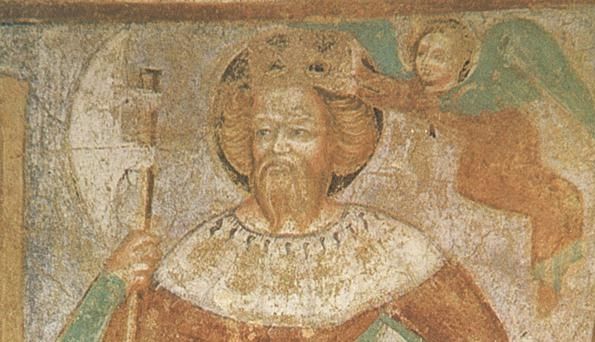
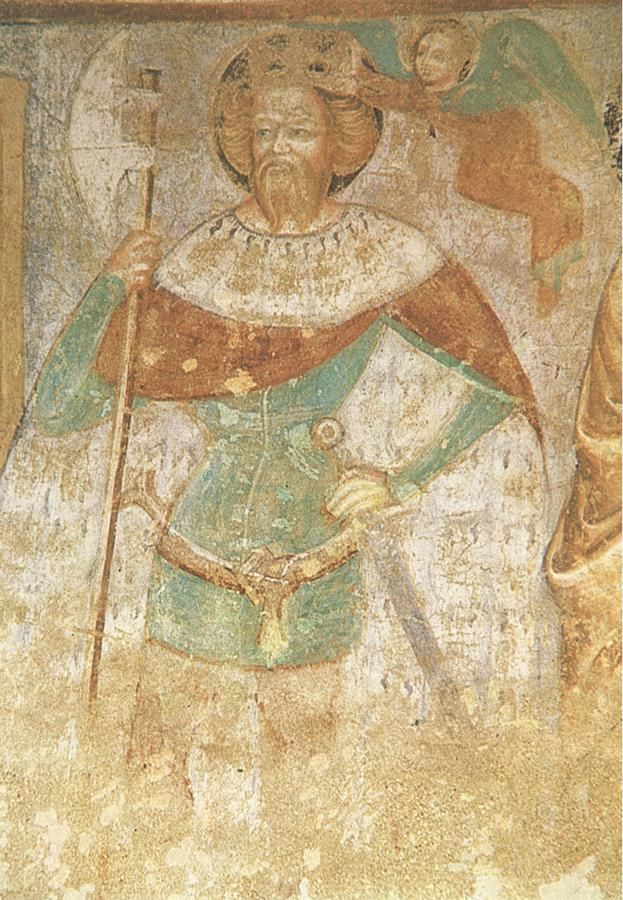
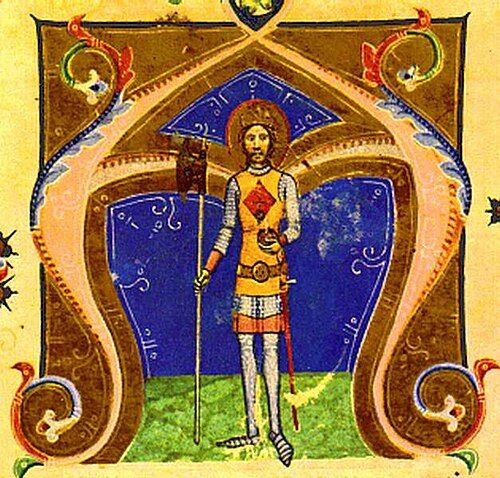
In the picture below: in the fresco detail of the Holy Trinity Church in Velemér, Vas County, in the Árpád-era “church of light”, an authentic portrait of Saint Ladislaus, the holy king of the Kingdom of Hungary, one of the richest and most powerful* kingdoms of medieval Europe, looks down on us. This is one of the oldest, unparalleled Árpád-era stone buildings in the Őrség, painted by János Aquila in 1378. The second picture is from the Picture Chronicle.
*:The territory of the medieval Kingdom of Hungary followed the natural geographical borders of the Carpathian Basin. In its heyday, in the 13th-14th centuries, the empire reached an area of 300,000 – 330,000 km², making it one of the largest and most powerful territorial powers in Europe. The extent and borders of the kingdom In the North and East: The natural border was the Carpathian Mountains (in addition to the core territory of Hungary, the Uplands, Subcarpathia and Transylvania). In the South-West: The crown controlled the strategically important southern territories, Croatia, Slavonia, and at certain times also parts of Dalmatia and Bosnia. To the South: Until the Turkish expansion, the border was secured by a system of border fortresses built along the southern rivers (Sava, Danube).





Discussion
No comments yet.